From Rhetoric to Algorithms: how we learned to think about communication
A short history of the ideas that still shape how we communicate today
We tend to think of communication as something we simply do. We speak. We write. We present. We publish. We post. We send. But communication has been studied for thousands of years precisely because it is not quite that simple. A message can change someone's mind. It can influence a decision, create trust, cause fear, mobilise a population or protect someone from harm. It can inform, manipulate, persuade, connect or divide.
As the tools of communication changed, the communication ecosystem changed with them — and so did the way we thought about communication.
I wanted to understand that evolution through ten ideas that changed how we think about communication, from Ancient Greece to the communication environment we inhabit today.
I split the journey into two visual timelines:
Timeline 01 — Classical Foundations looks at Ancient Greece, Aristotle, Plato, Cicero and Quintilian.
Timeline 02 — The Expansion of Communication follows Gutenberg, the rise of mass communication, Lasswell, Shannon & Weaver and McLuhan.
The names and dates are important. But for me, the more interesting question is: what changed in our understanding of communication each time?
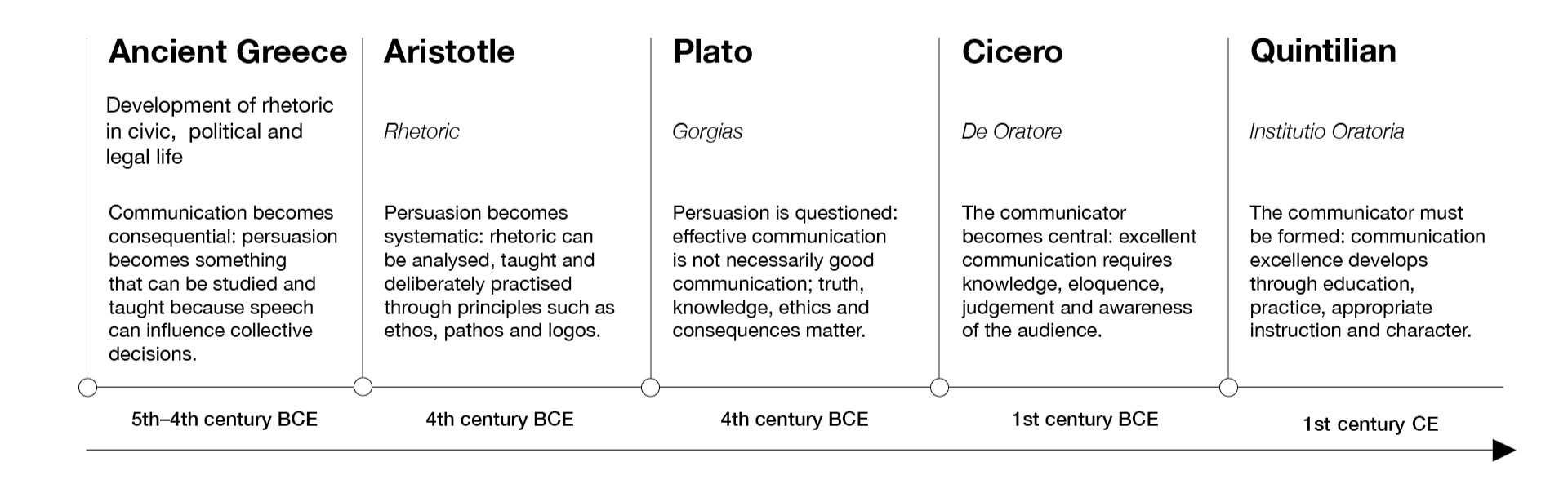
Timeline 01 — Classical Foundations
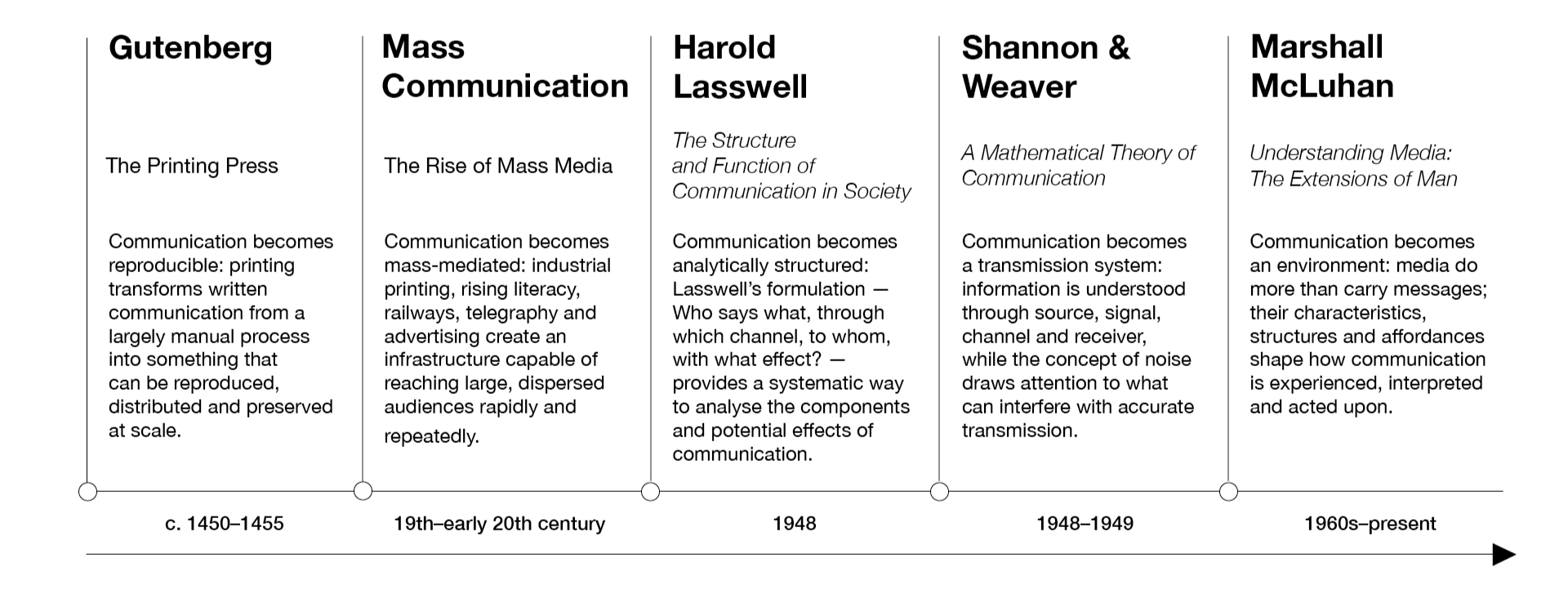
Timeline 02 — The Expansion of Communication
Before communication became a discipline, it was already a powerful ability
In Ancient Greece, particularly within civic, political and legal life, public speech could influence decisions that affected the community. That matters. Persuasion was no longer simply something people happened to be good at. The ability to argue, defend a position and influence an audience could affect collective decisions.
Communication becomes consequential.
And once persuasion has consequences, understanding how it works becomes valuable. This is where I see the beginning of something important: communication starts becoming something that can be studied, practised and deliberately improved.
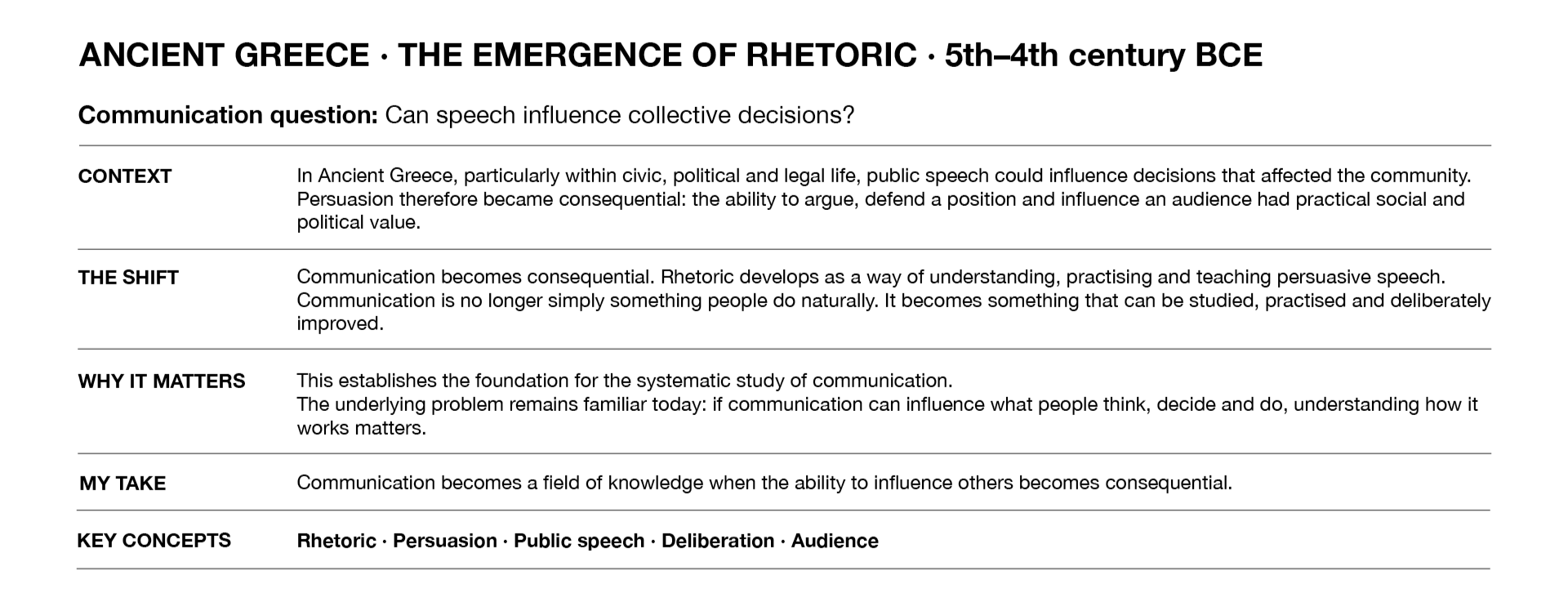
Aristotle: persuasion becomes systematic
Aristotle took this one step further. Rather than treating persuasive ability simply as an innate talent, he examined the principles and means through which a speaker could influence an audience.
Ethos. Pathos. Logos. Credibility. Emotion. Reasoning. Three ways Aristotle understood how a speaker could persuade an audience.
I find it remarkable that this framework has survived for more than two thousand years. Aristotle essentially transformed persuasion from something people do into something people can systematically understand and deliberately practise. And I think this is one of the first lessons for a communicator today:
If we understand how communication works, we can become more deliberate about how we use it.
That is a very different proposition from simply being a good speaker.
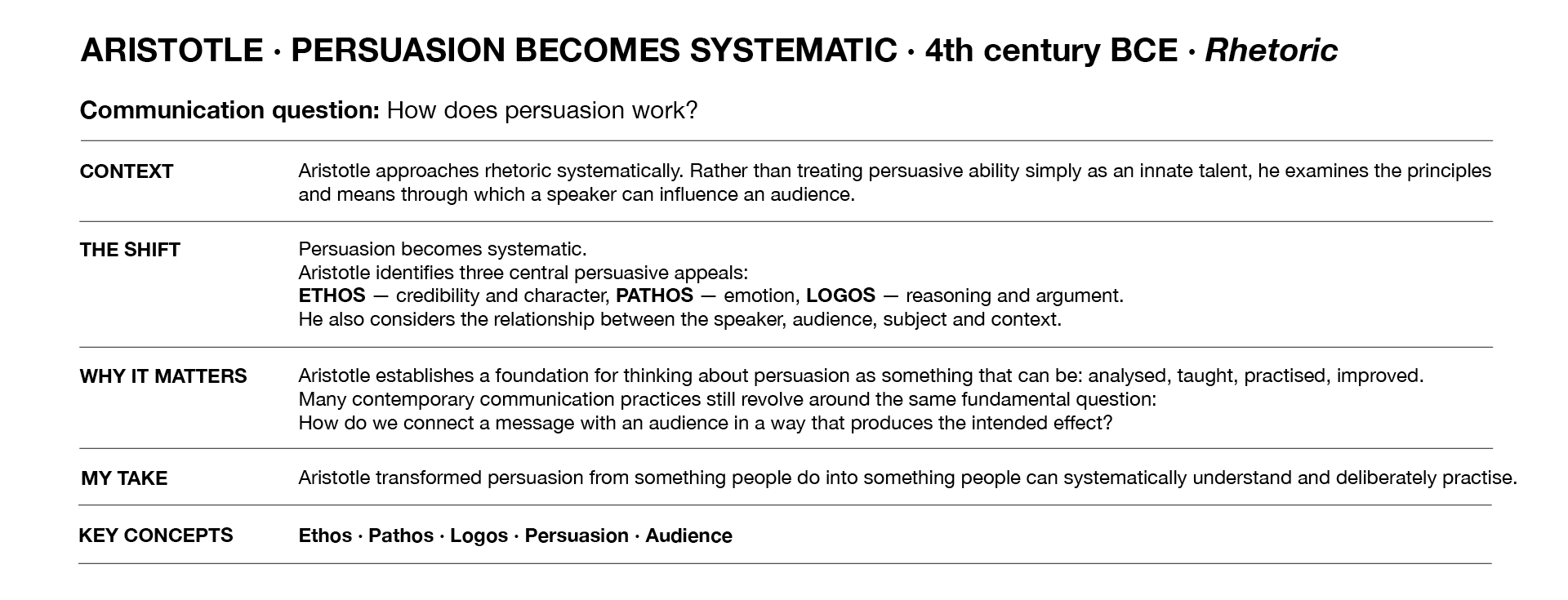
Plato: but does effective communication make it good?
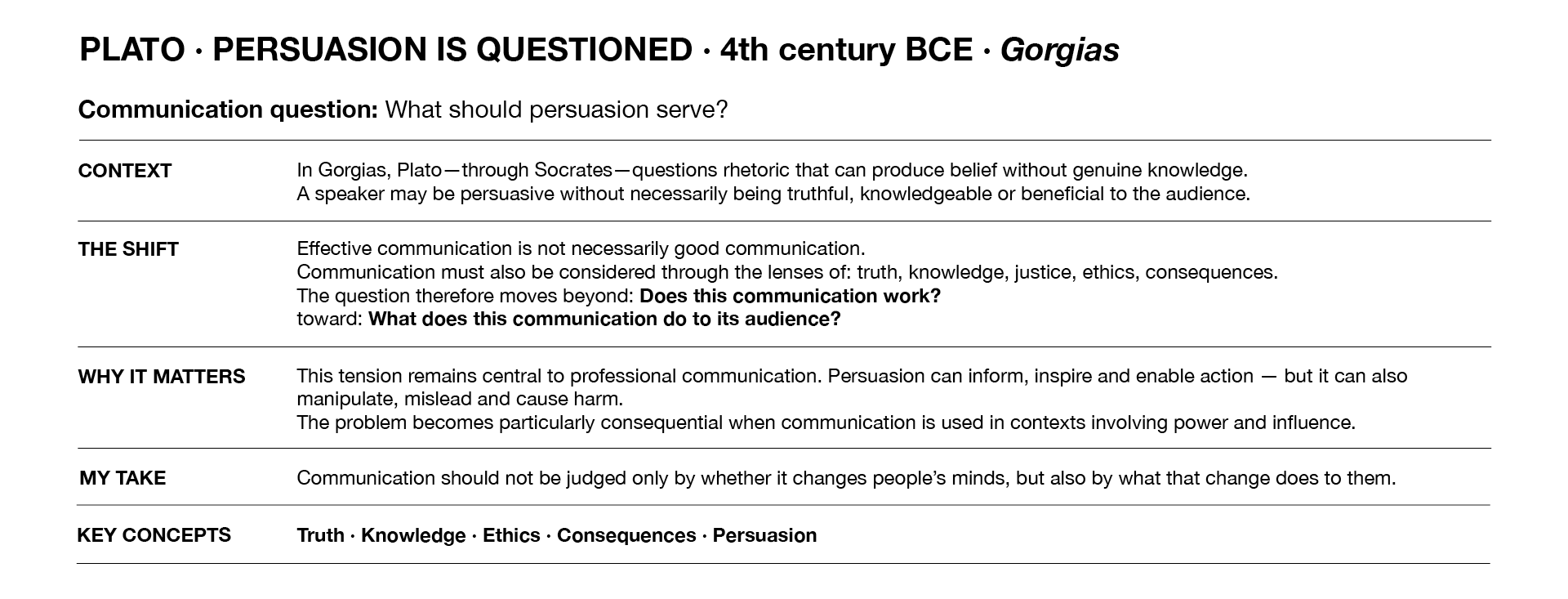
Then comes Plato, and the conversation becomes much more uncomfortable. In Gorgias, Plato — through Socrates — questions rhetoric that can produce belief without genuine knowledge. A speaker can be persuasive without necessarily being truthful, knowledgeable or beneficial to the audience.
This introduces a tension that I find extremely relevant today: what is a good speech or a good communicator if what they communicate is not true or beneficial to their audience?
For Plato, being effective at persuasion isn't enough. A communication can successfully change someone's mind and still be untrue, unjust or harmful. Communication has to be considered through the lenses of truth, knowledge, justice, ethics and consequences.
The question moves beyond “does this communication work?” towards “what does this communication do to its audience?”.
This is particularly interesting because it made me understand that the role of the communicator is more impactful than I had initially believed.
Communication can change what people think and do. The more influence a communicator has over those decisions, the greater their responsibility for how that influence is used.
My position at this point is quite simple: communication should not be judged only by whether it changes people's minds, but also by what that change does to them.
Cicero: the communicator matters too
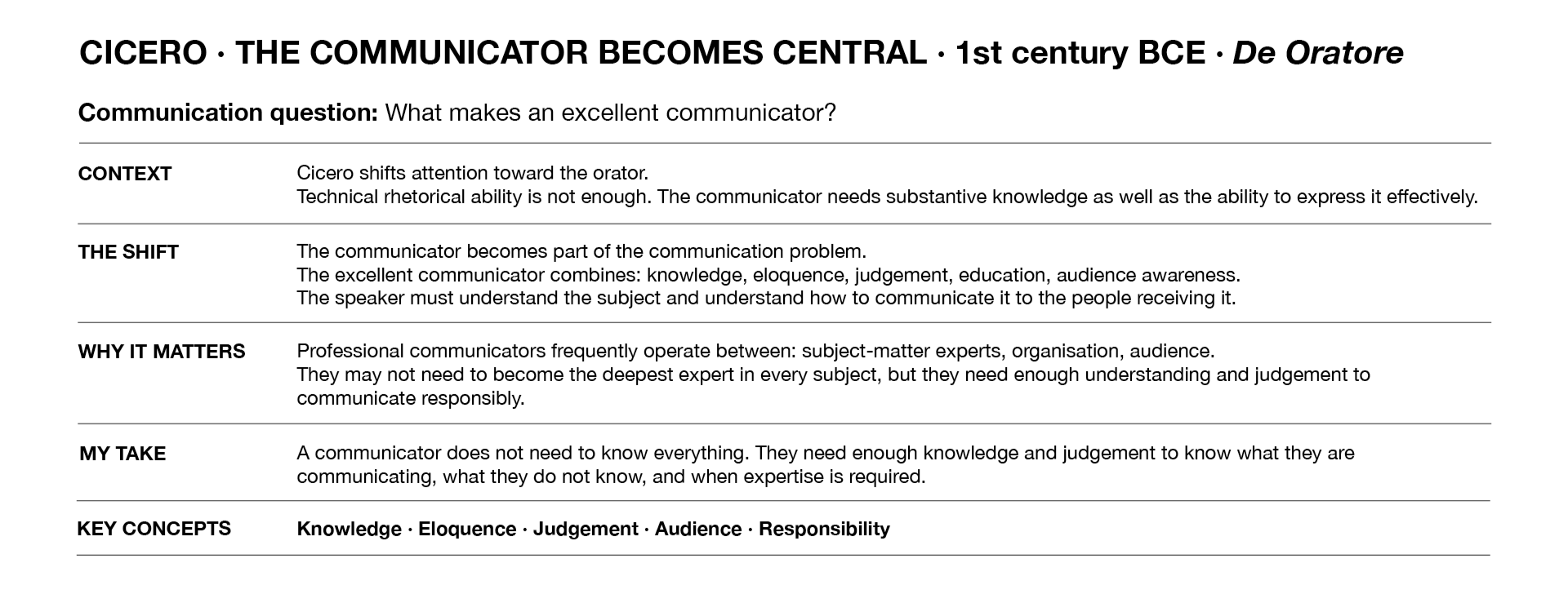
Cicero expands the picture again. An excellent communicator, in his view, needs more than rhetorical technique. They need knowledge, eloquence, judgement, education and awareness of their audience.
This made me think about the role of the professional communicator today. We often sit between subject-matter experts, organisations and audiences. We may not need to become the deepest expert in every subject we touch. But we need enough knowledge and judgement to understand what we are communicating, what we do not know, and when expertise is required.
A communicator does not need to know everything. They need enough knowledge and judgement to know what they are communicating, what they do not know, and when expertise is required.
That feels particularly important when communication happens in complex or regulated environments.
Quintilian: the communicator must be formed
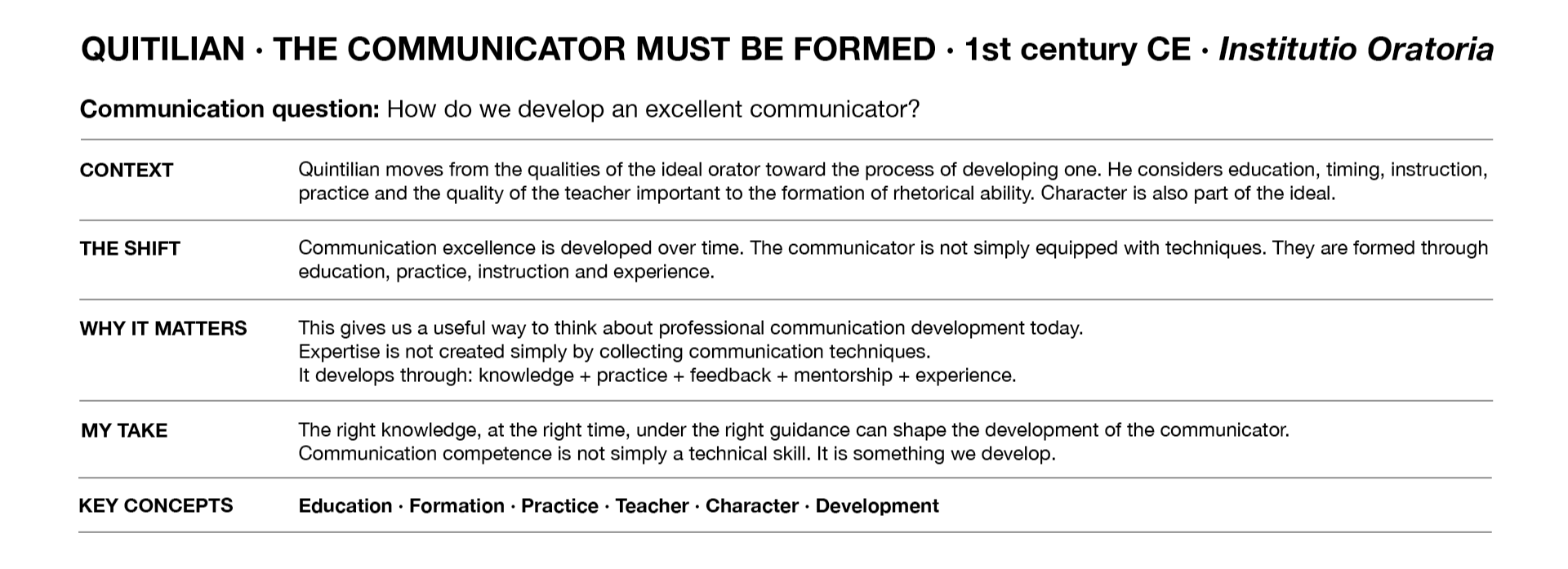
Quintilian moves the conversation from what makes a good communicator to how one becomes one. He is concerned with education, timing, instruction, practice and the quality of the teacher. Character is also part of the ideal.
As a mother, I found this particularly interesting because Quintilian's ideas extend beyond the communicator themselves: he also considers the role of education, teachers and parents in developing communication ability.
The principle that the right knowledge, at the right time, under the right guidance can shape the development of a communicator stayed with me because it makes communication competence feel less like a talent and more like something that can be deliberately developed. Communication competence is not simply a technical skill. It is something we develop.
And that development involves: knowledge + practice + feedback + mentorship + experience. This feels surprisingly contemporary.
Some people may discover an inclination towards communication early and eventually develop it into a profession. Others may develop strong communication abilities and take them into entirely different professions. Either way, communication remains a skill that travels across professions.
Then the environment changes
Up to this point, most of our thinkers are primarily concerned with people: the speaker, the audience, persuasion, knowledge, ethics, education and character. Then something happens that changes the scale of the entire system. The technology changes.
And once the technology changes, the communication relationship changes with it.
Gutenberg: communication goes on steroids
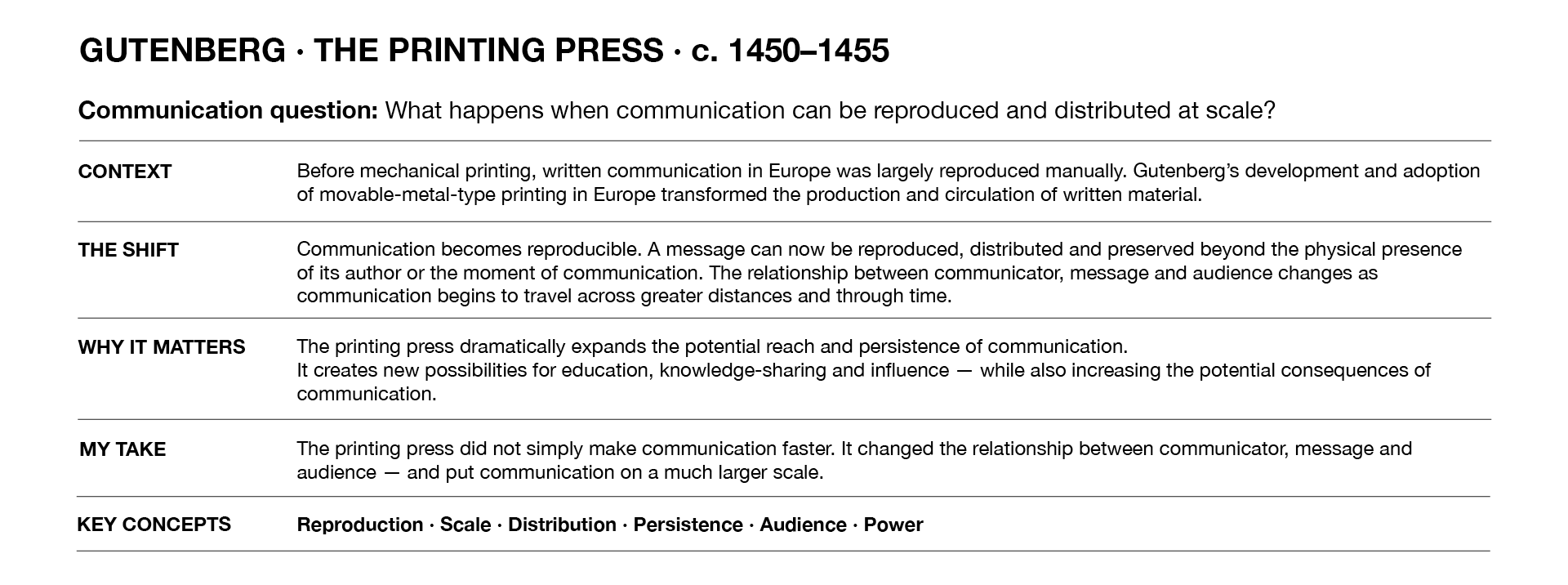
The printing press did more than make communication faster. It also changed its scale.
Before mechanical printing, written communication in Europe was largely reproduced manually. Gutenberg's development and adoption of movable-metal-type printing in Europe changed how written communication could be produced and circulated.
A message could now be reproduced, distributed and preserved beyond the physical presence of its author or the moment of communication. The scale at which a communicator could reach audiences across distance and time changed dramatically. This is when communication starts to acquire a different kind of power.
The printing press put communication on steroids.
It expanded what could be communicated, who could become an author, who could become a reader, how ideas could travel and how long they could remain available. The ecosystem became larger. And with greater reach came greater consequence.
Mass communication: the audience becomes a mass
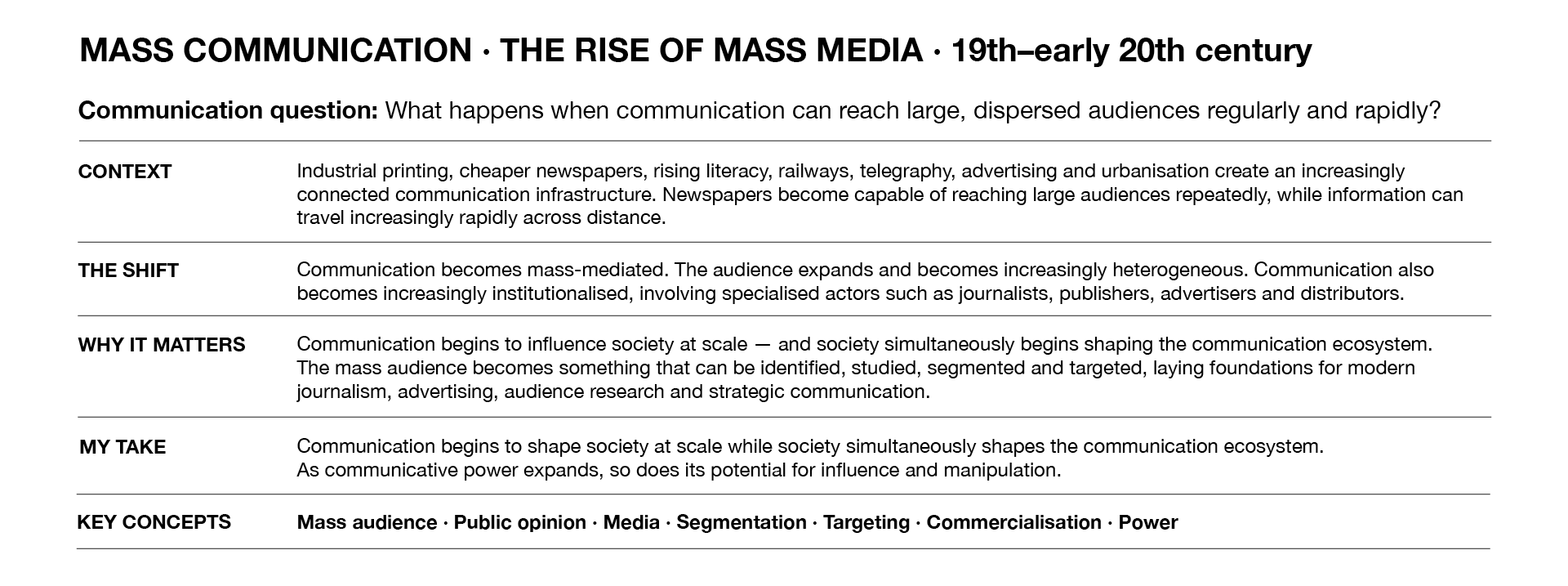
The next transformation is both technological and societal. Industrial printing, cheaper newspapers, rising literacy, railways, telegraphy, advertising and urbanisation create an increasingly connected communication infrastructure.
Communication can now reach large, dispersed audiences regularly and rapidly. The audience becomes colossal. And this creates a new professional problem:
How do you communicate when the people receiving your message are no longer one audience in the traditional sense, but a mass of people with different interests, needs, values, circumstances and expectations?
This is where audience thinking becomes increasingly important. Audiences can be identified, studied, segmented and targeted. Communication becomes increasingly institutionalised too, involving journalists, publishers, advertisers and distributors.
The relationship between communication and society becomes increasingly reciprocal. Communication shapes society. Society shapes the communication ecosystem.
The communicator's power grows again because a message can now reach large audiences repeatedly and across distance. So does the potential for influence and manipulation.
Lasswell: communication becomes something we can map
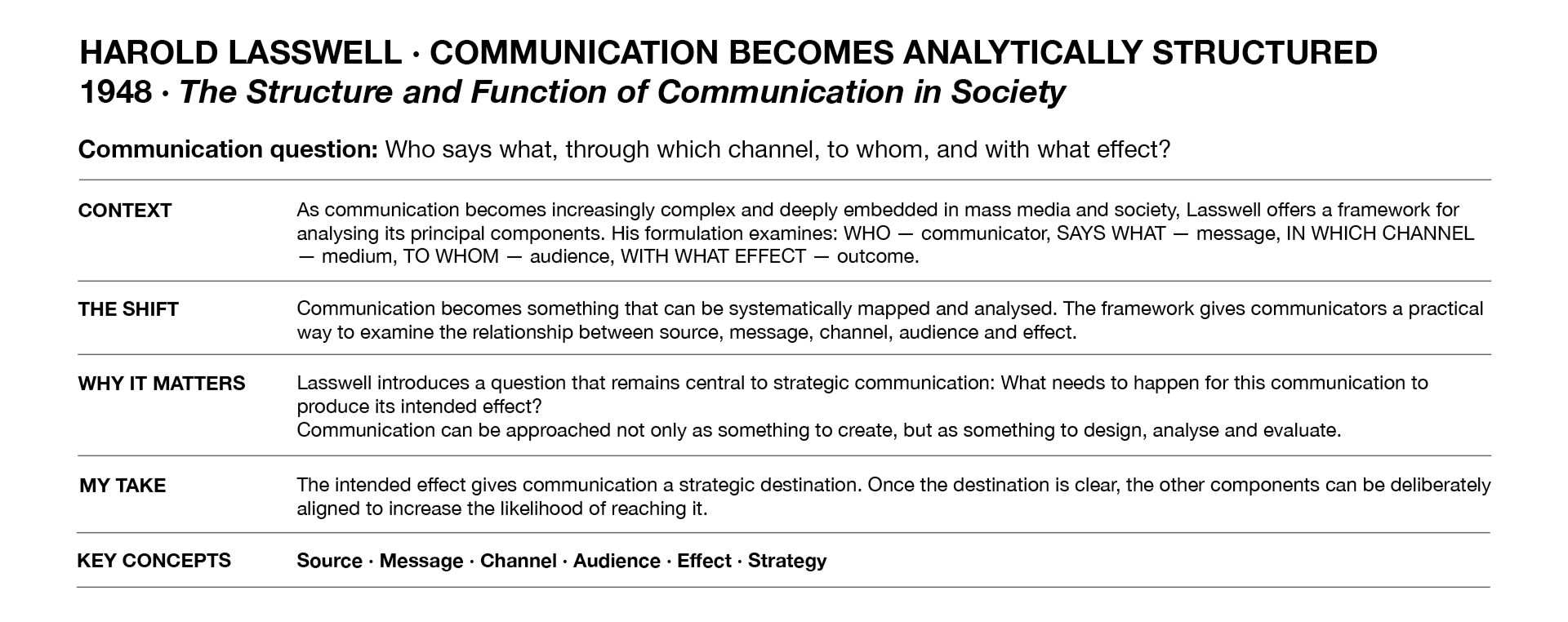
By 1948, communication has become complex enough that we need ways to systematically analyse it. Harold Lasswell offers a deceptively simple question:
Who says what, through which channel, to whom, and with what effect?
I find the last part particularly important: with what effect? Because it shifts attention from what we send to what happens as a result. The five components — source, message, channel, audience and effect — give the communicator a way to look at communication as a system rather than simply a piece of content.
And this is when I started seeing a stronger connection to strategic communication. If the effect is the destination, then the other components can be deliberately aligned to increase the likelihood of getting there. The message. The source. The audience. The channel. The context. The desired outcome.
When I apply this framework to a complex crisis such as the 1982 Tylenol crisis, its practical value is clear. There isn't simply a matter of messaging. There are multiple stakeholders, multiple channels, different information needs, urgency, uncertainty, reputation and public safety. Lasswell gives us a way of beginning to map that complexity.
Shannon & Weaver: what happens when the message gets lost?
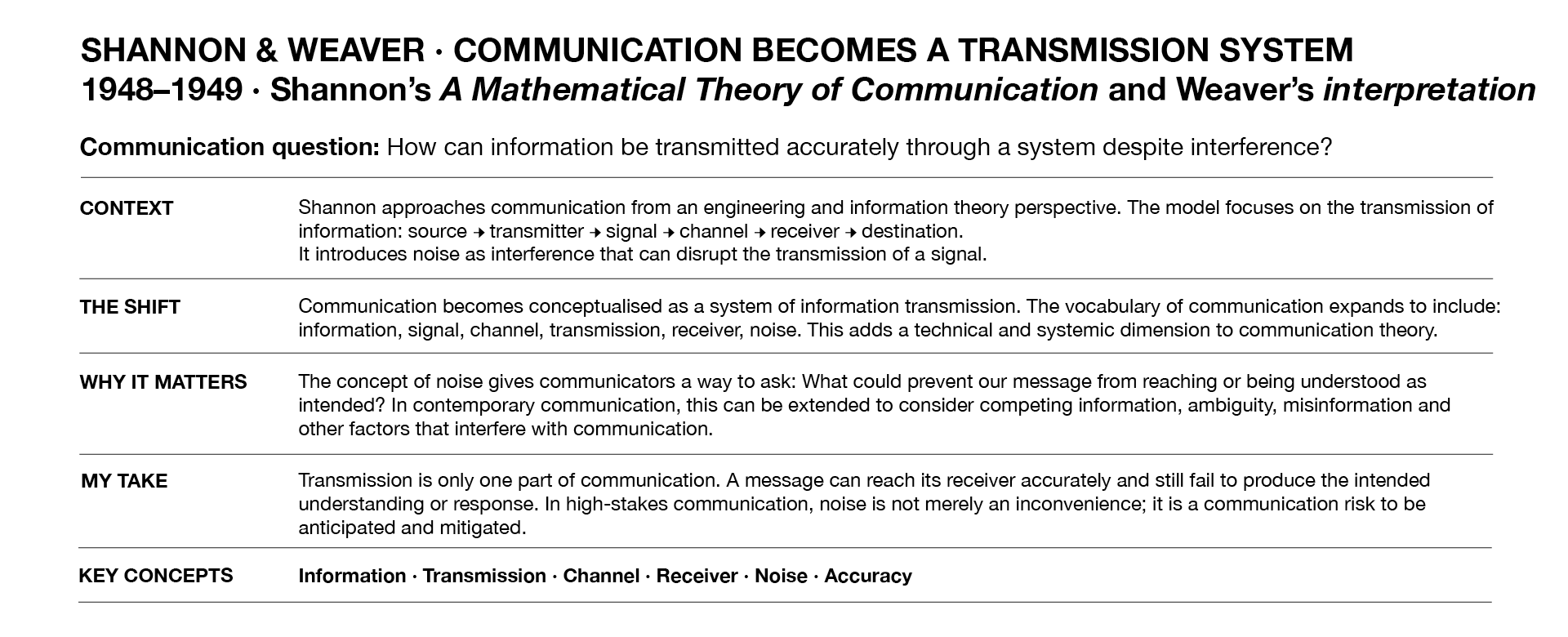
Shannon & Weaver introduce another perspective. Their approach is technical and systematic, concerned with the transmission of information and the accuracy of that transmission. Source. Signal. Channel. Receiver. And, importantly: noise.
In an engineering context, noise can disrupt the signal. In contemporary communication, the broader idea can help us think about competing information, ambiguity, misinformation, speculation or other factors that interfere with how a message is received or understood.
The same Tylenol crisis also makes Shannon & Weaver's concept of noise practical. There is urgency. There is uncertainty. There are investigations. There are multiple actors. There is public fear. There is media attention. There is speculation. Noise becomes more than an inconvenience in crisis communication.
It becomes a communication risk to be anticipated and mitigated during a crisis.
This also made me see the limitation of looking at communication only as transmission. A message can reach its receiver accurately and still fail to produce the intended understanding or response. As human communication is not just about whether the signal arrived. It is also about what happened when it arrived.
McLuhan: the medium changes the experience
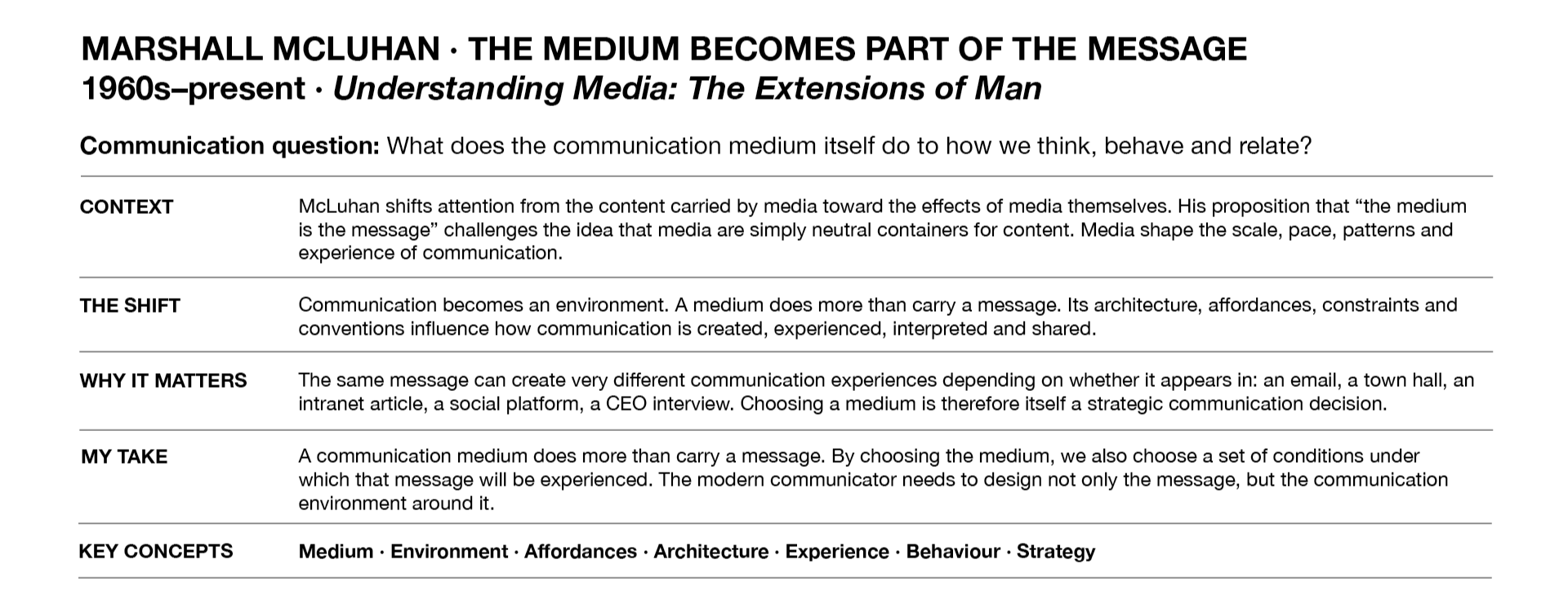
And then we arrive at McLuhan. His famous proposition that “the medium is the message” shifts attention again. Instead of looking only at what the message says, we start asking:
What does the medium itself do?
I really like this idea because I see it somewhere between strategy and meta-communication: the medium itself tells us something about how the message should be experienced. When we choose a medium, we say more than the content itself says.
Imagine a company-wide leadership announcement. If we choose email, we are already communicating something about the scale, formality and nature of the message — before the audience has read a single word. And once we choose email, the message has to follow the conventions of email. It is likely to be written. It can include links, attachments, images, quotes and supporting material. It can be sent to specific groups or to everyone. It creates a particular experience. Now compare that with a town hall. Or an intranet article. Or a Viva Engage post. Or LinkedIn. Or a CEO interview.
The underlying information could be exactly the same. The communication is not.
Each medium comes with different restrictions, standards, audience expectations, possibilities for interaction, tone and calls to action. So choosing a medium is itself a micro-strategic decision.
McLuhan deepened my understanding of the communication ecosystem. A medium gives us more than somewhere to put a message. Its architecture and the ways it allows us to interact encourage particular behaviours, expectations and ways of communicating — often before we are consciously aware of them.
The modern communicator therefore needs to design the message and the communication environment around it.
So what actually changed?
Looking back at the ten points, the evolution becomes clear.
We started with communication as something that could influence collective decisions. Then persuasion became something that could be systematically studied. Then we questioned whether effective persuasion was good communication. Then we became more interested in the communicator — their knowledge, judgement and character. Then we considered how the communicator should be formed.
And then technology dramatically expanded the system. Communication became: reproducible. Then: mass-mediated. Then: analytically structured. Then: a transmission system. And finally: an environment. The communicator is no longer the only thing we need to understand. Neither is the message. Neither is the channel. We have to think about the whole ecosystem.
And yet, the oldest questions are still here
This is probably what surprised me most about the exercise. The communication environment has changed almost beyond recognition, but the oldest questions are still here.
Speech became manuscript. Manuscript became print. Print became mass media. Mass media became electronic media. Electronic media became digital, social, mobile and networked. And now we are communicating in an environment increasingly shaped by algorithms and artificial intelligence. The scale and speed of change over the past four or five centuries is extraordinary. But the questions Aristotle, Plato, Cicero and Quintilian were asking have not disappeared. They may actually be more relevant now than ever.
Who is speaking? Why should we believe them? Who is the audience? What do they need? How should the message be constructed? What effect are we trying to create? What happens when communication is persuasive but untrue? What happens when communication is powerful but irresponsible? Who should be allowed to exercise that power? How should communicators be educated?
And perhaps the biggest question: what does our communication leave the audience with?
From rhetoric to algorithms
I started this exercise expecting to learn something about the history of communication, and I did. But I also ended up thinking much more about the responsibility of the communicator in our societies. Communication's priority should be to best connect a message to an audience, for the best outcome for that audience. And ethics and a good heart should lead communication.
That might sound idealistic and perhaps it is. Plato would probably have approved of the concern, while questioning whether communicators actually live up to it. And history gives us plenty of reasons to be sceptical.
The communicator's power has grown enormously. The tools available to us have become faster, more scalable and more sophisticated. We can reach millions of people instantly. We can personalise messages, segment audiences, measure behaviour and increasingly use machines to generate communication itself.
But the foundational questions have not become obsolete. They have become harder. And perhaps, beyond the history of communication, this is the biggest lesson I take from the ten points:
The tools of communication keep changing. The responsibility to understand what communication does to people does not.
Enormous credit is still due to Aristotle, Plato, Cicero and Quintilian. They had much less to work with. No printing press. No mass media. No television. No social platforms. No algorithms. No AI. And yet their work still gives us useful ways to think about persuasion, truth, knowledge, the communicator, the audience and responsibility.
Perhaps theirs is the most impressive innovation of all.
They came from much less — and still gave us questions that survived almost everything that came after.